EPL part of county initiative focusing on boosting kindergarten readiness
Six in 10 kids in Elkhart County enter kindergarten unprepared.
Solutions are neither easy nor quick. But a coalition of local organizations has come together to focus on families and address big problems.
Backed by data, the Building Strong Brains initiative is creating a safety net of solutions to catch kids before they get behind.
The trends are looking positive, according to Kim Boynton, executive director of Building Strong Brains, and Elkhart County has deep resources and a wealth of expertise to address issues.
Being kindergarten-ready
Kindergarten readiness is a measure of both physical and mental skills. Students need both to best succeed in the classroom.
“Things like answering questions, being able to navigate their environment, being able to interact with peers,” Kim says. “When we looked at that, we knew that as a community, we want better for our children and families.”
When kids aren’t ready, it impacts the classroom. Teachers need to spend more time on skill development instead of subject areas like reading and math. One skill, self-regulation, involves children having positive emotional response skills in upsetting situations.
“Seeing the trend in self-regulation skills, just knowing the importance of that, it resonated with kindergarten teachers. It’s a lot easier to teach (students) other things,” says Dr. Aliah Carolan-Silva, vice president of research for Horizon Education Alliance.
The difference must be made long before kids reach the classroom, Kim adds. Areas impacting this particular skill can be traced to:
• Access to early and adequate prenatal care;
• Access to appropriate housing and nutrition;
• Use of well-child visits with healthcare providers; and
• Participation in safe and stimulating environments, such as childcare, public libraries, community centers, or even at home.
“We know we have to start earlier. We have to help impact some of those earlier opportunities for children to be ready to learn and thrive,” says Kim.
Kim says this includes a wide variety of things like:
• Prenatal care
• Affordable housing and food
• Well-child visits
• Safe and stimulating play areas for children
Foundations for learning
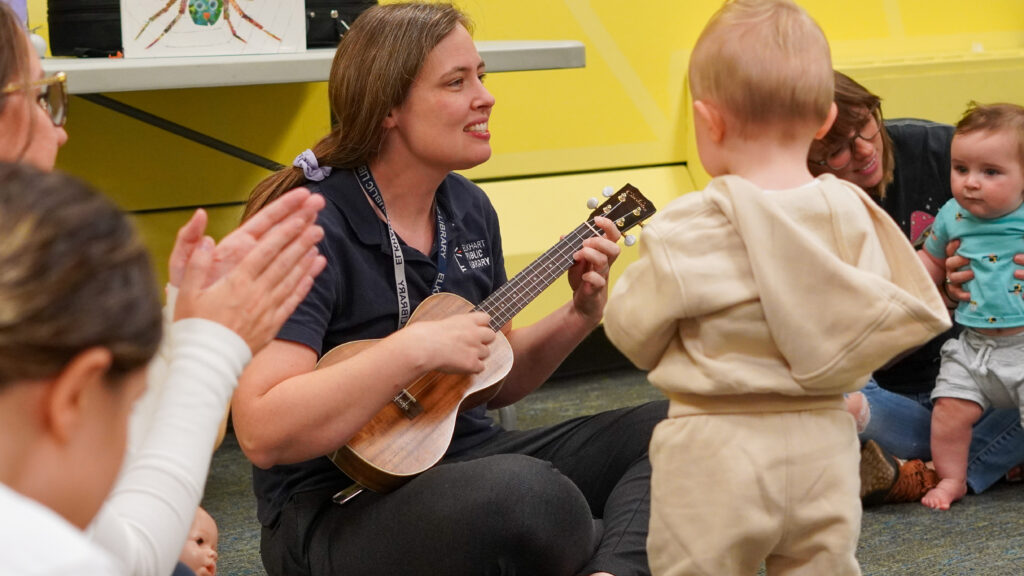
Allison McLean, head children’s librarian at Elkhart Public Library, leads the weekly Baby and Me storytime program downtown and works with families daily. She sees first-hand the difference early literacy efforts can make.
“Kids need a foundation of security before they can learn,” she says. “Elkhart (County) has a lot of resources but the people who need them don’t know about them.”
She became involved with Building Strong Brains in 2023. She’s a member of the action team working on support for families, and part of the work includes leading conversations with parents.
From these discussions, the coalition intends to collect information and help organizations understand what they don’t know about the families they’re trying to reach.
The coalition can’t do this work without including those who will benefit from it, she says.
“It’s good that we’re working together, but the parents have to be at the table, too. What barriers do they have that we aren’t aware of yet?” Allison says. “Not everything is going to work for every family, so it needs to be individualized.”
The work is just beginning, Kim and Allison both say, but the momentum and excitement are real.
“It feels like it’s going to make a change,” says Allison.
Building a coalition
Leaders at Horizon Education Alliance have an unofficial motto that drives data gathering.
“We measure what matters,” says Aliah Carolan-Silva, the group’s vice president.
After developing the Early Childhood Skills Inventory about 10 years ago, the next step was to bring organizations together to change outcomes.
Building Strong Brains started in 2022. The Community Foundation of Elkhart County brought together stakeholders delivering early childhood success. Organizations like HEA, CAPS, Beacon Health System, Crossroads United Way, Heart City Health and more are involved.
Kim Boynton leads the effort, which now has 11 sponsoring organizations.
“The coalition started with a desire to improve those kindergarten readiness scores. What we know is, it starts way before kindergarten,” Kim says.
They studied broad issues: maternal and child health; high-quality childcare and early learning programs; and community support for families. The coalition listened to community members and found out what families needed. Action teams were formed to focus on each item.
“If families are supported, children will arrive ready to learn and thrive with all of those skills they need to be able to succeed,” says Kim.
The first successes:
• Find Help, a community tool for families to search for low-cost and free resources;
• Lantern, formerly Bright by Text, a message service for families to learn more about childhood development and community events; and
• Greater promotion of services like Triple-P for Baby, which offers support for families transitioning to parenthood.
“The early start is really important for laying the foundation for the future of children and their families,” Kim says.
Reaching families early is a key component for long-term success, she says.
What parents can do
Public libraries fit into the overall mission of Building Strong Brains, Kim says, because they are connectors for the community.
“The library has been very engaged as one of our partners from the beginning. We know libraries are somewhere families go,” she says. “They go for a variety of reasons. For interaction opportunities, programmatic pieces, and resources.”
Library staff help parents get their children kindergarten ready through weekly Storytimes, educational programs, and initiatives like 1,000 Books Before Kindergarten.
Parents at Elkhart General Hospital receive a bag with 1,000 Books Before Kindergarten materials when they leave the maternity ward. Allison hears from those families when they visit Elkhart Public Library.
“Sometimes they have started it and sometimes they haven’t because it’s crazy when you first have a baby,” Allison says.
Babies benefit greatly from being read to beginning in those first months, she says.
“Parents might not think about reading to them at such a tiny age, but it’s another new thing,” she says. “We love to show new moms the board books that are best for babies that age. High-contrast books are good for babies in the first six months. It’s just about exposing them to language.”
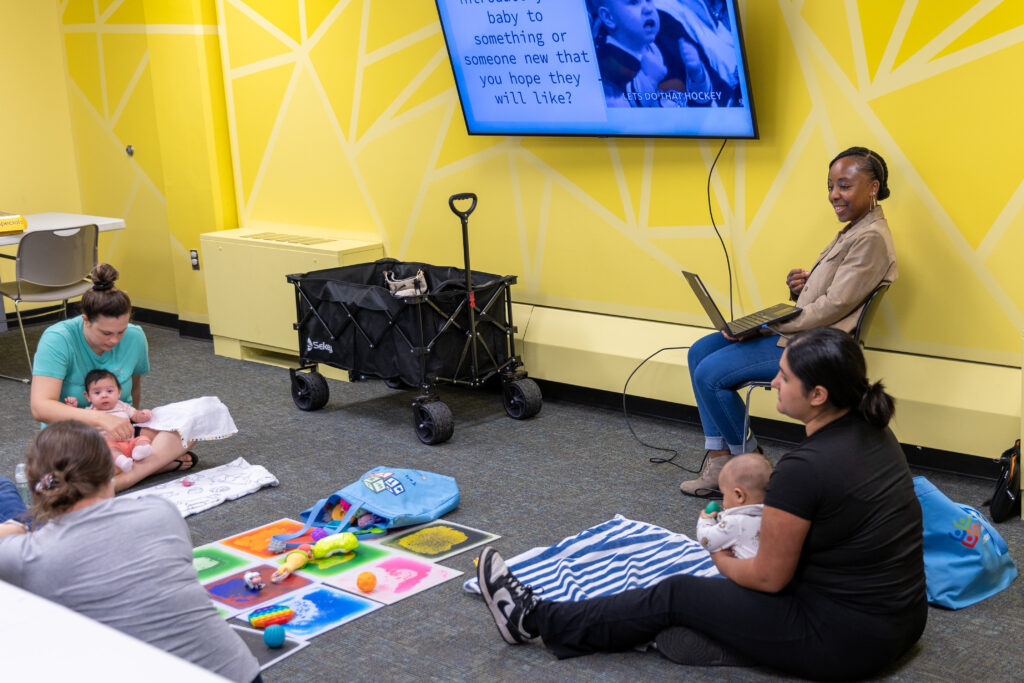
Weekly Storytimes let parents see other ways they can make reading fun. The sessions also introduce classroom-type activities and social interaction. Sitting in a group and quietly listening to an adult other than a primary caregiver are skills kids need when they head to school.
Books also offer a lot of background knowledge kids need, Allison says.
“Concepts that they’re going to come across in school, knowing a bit about those things helps. We can’t all go to space or other countries. But books will, which is why reading is so great,” she says.
Additionally, Allison works with other organizations in the area to bring their programs to EPL. Notre Dame’s Robinson Community Learning Center hosted an eight-week Talk With Your Baby class to the downtown library this fall.
Overall, the library offers materials and strategies for parents to start language and literacy development.
“The library isn’t just a place where you’re waiting for people to come anymore,” says a Community Foundation of Elkhart County spokesperson. “… The library positions itself as a community partner in different ways than it used to. That is a tremendous benefit for something like Building Strong Brains and others who are trying to do this work with a range of partners.”
Next steps
Kim and Allison both say the coalition’s work is still early in the process. Small successes are visible. Significant improvements in the most recent batch of IREAD test scores may be one.
It will take time to realize long-lasting change.
Meaghan Bylsma, data and evaluation manager for Horizon Education Alliance, says it’s too early to go deep into the data and draw conclusions about test scores being tied to the coalition’s work. But all growth is important.
“This was the first year kids who didn’t have any covid-related learning disruptions took IREAD,” Meaghan says. “The state (had scores) in the high 80s in 2016 to 2019, and now we’re back to where they were.”
Educating parents about the importance of kindergarten readiness will be an ongoing effort.
Over the summer, Building Strong Brains hosted a Head Start boot camp. Focused on children without access to early learning opportunities, Kim says, the eight-week program built readiness skills for students.
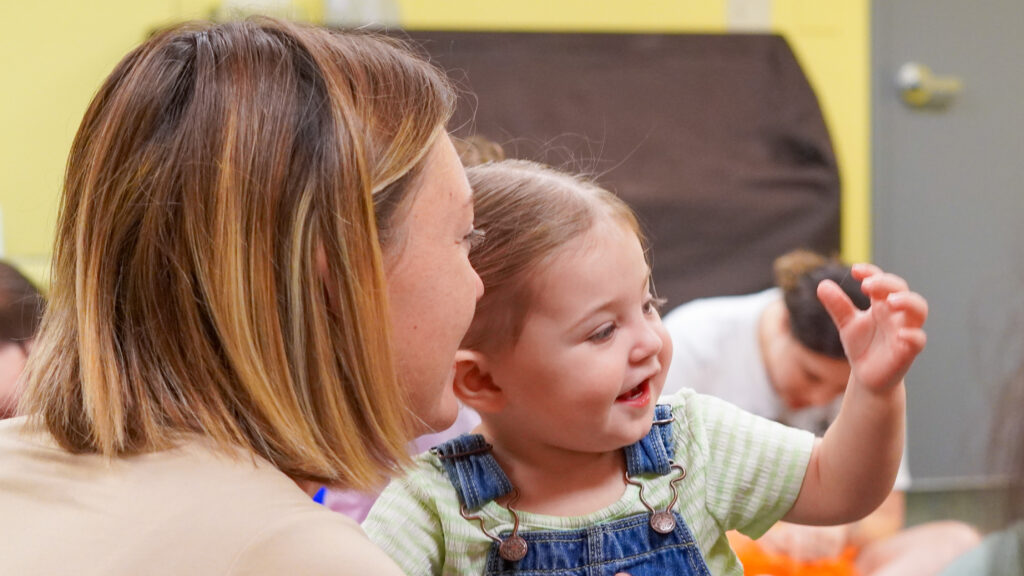
Allison says she hosted Storytimes at Mary Daly Elementary’s preschool to help prepare those kids for the classroom.
EPL offers a kindergarten assessment for preschoolers, too, Allison says.
“The best time for the assessment is the spring before they head off to school. Parents can see where their child is at and get tips on how to help them get to where they need to be,” Allison says.
Visit the downtown library or MyEPL.org/prek to schedule an assessment.
Educating parents and reaching kids sooner is all part of the overall goal to continue to see rising reading and readiness scores.
“It takes years to build a foundation to learn to read,” says Allison. “It has to start with exposure to different vocabulary. That’s where books come in. They have such a bigger vocabulary than what we use in our everyday language.”
Kim says the best outcome is building a community that empowers parents to lead child development.
“Parents and children are at the center of the work we’re doing,” she says. “We want to ensure that children are ready to thrive when they arrive in kindergarten. We know there’s a connection from positive early experiences, kindergarten readiness, third-grade reading and continuing through career pathways.
“That early start is really important for laying the foundation for the future of children and their families,” Kim says.
Building the county data
Lagging test scores prompted community leaders to investigate kindergarten readiness about a decade ago. They uncovered no standard for measuring a child’s school preparedness.
Horizon Education Alliance helped build the Early Childhood Skills Inventory using input from educators and community groups.
“We worked with stakeholders to come up with the assessment,” says Dr. Aliah Carolan-Silva, vice president of research for Horizon Education Alliance. “We had an impact committee around community projects that really decided that we wanted as a county assessment.”
Kindergarten teachers provided lists of skills they thought were most important for students to have entering their classrooms. This also became the baseline for data collection.
“We looked at approaches to learning, self-regulation and physical development skills,” says Aliah.
The ECSI three items related to social skills, and three more on physical skills. Teachers complete the assessment in the first weeks of kindergarten. Each item is ranked on a three-point scale based on how often a student demonstrates them independently.
The findings? Only about 40 percent of kindergarteners enter school using the six skills all or most of the time. New students generally tend to lag in social and self-regulation skills.
Grouping skills by category and further studying all items together helps create a snapshot of how often children use their skills. HEA has seven years of local numbers to examine, and it recently launched LeadElkhartCounty.org as a community data dashboard.
The survey was not completed in 2020 due to the pandemic.
Then, in 2024, the state of Indiana adopted a deeper assessment tool that Aliah says offers new and different data to ultimately serve a better purpose.
“(ECSI) was more of a snapshot. It was also really intended for that purpose,” she says. “We’ve seen really good consistency. It was not intended to implement individual student or classroom plans. It’s supposed to inform on how ready the county’s students are for kindergarten.”
Collecting and understanding the data helps lay the basis for the coalition’s work on kindergarteners’ skill development, she says.
“I think having that data can be a really good rallying point. It takes a county-wide approach to support those families that need help,” Aliah says. “You do see (kindergarten ready) skills develop with access to preschool or those social environments.”
Get involved
Parents: Building Strong Brains wants to hear from parents about resources and support they need. Reach out to Allison McLean, amclean@myepl.org, to schedule a conversation. Participating families can receive a $25 gift card for their time.
Organizations: To learn more and connect with the coalition, visit buildingstrongbrains.net/get-involved