
Bill Phillips created meaningful legacy as first Black councilman
No matter the circumstances, Bill Phillips was always going to work.
During World War II, he trained in a segregated unit. As the civil rights movement unfolded in the 1960s, he earned a historic seat on the Elkhart City Council. In an era when quality jobs were difficult to get, he rose to vice president of the local bank.
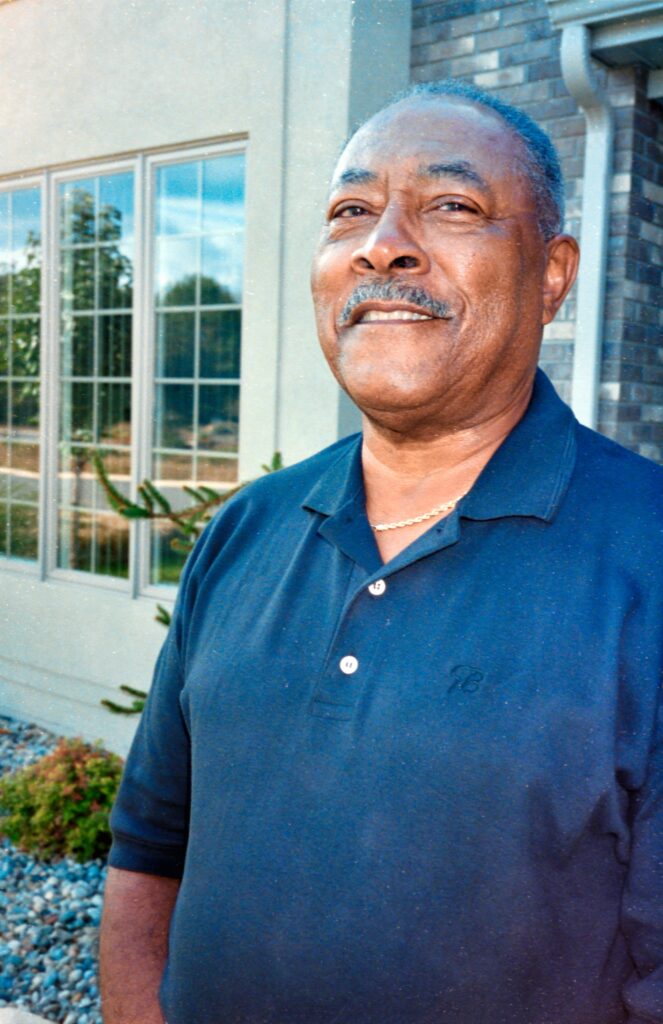
Every step of the way, Phillips was a leader and mentor.
“The ultimate measure of a man is not where he stands in moments of comfort and convenience,” the Rev. Martin Luther King Jr. said, “but where he stands in times of challenge and controversy.”
Phillips used that quote in 1971 to honor the retiring mayor. But Bill Phillips himself lived by those same high standards.
Chosen to represent
Politics was neither the beginning nor the ending point of Phillips’ career, but his timing was impeccable.
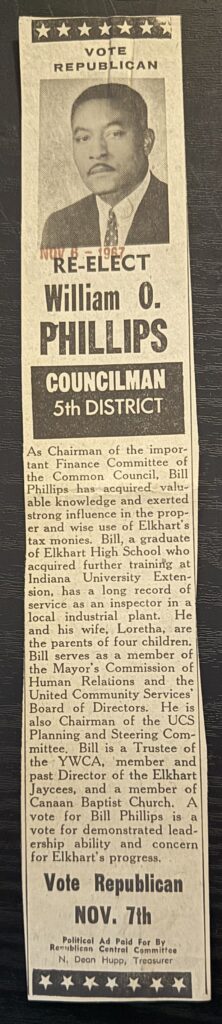
His city council victory in 1963 marked the first time a Black person had succeeded in a local election. The nation was coming to grips with past and ongoing discrimination. Social justice was making headway in the courts and halls of Congress.
Phillips knew Elkhart needed Black representation. He maybe wasn’t sure he was the one to run. He organized a group of local leaders to talk about potential candidates.
“A couple of weeks later, we met again and nobody had come up with a name,” Phillips told Elkhart Truth reporter Arden Erickson in September 1999. “Someone said, ‘Why not you?’”
Some criticized Phillips for running as a Republican. He lived at the center of a deeply Democrat area in the city. He had worked in the labor movement and alongside Congressman John Brademas. Phillips said his political beliefs, though, were strongly influenced by his parents, both staunch Republicans.
“I went over to the State Theater and talked to (Republican Party chairman) Bill Miller,” Phillips said. ”I told him I was going to run. He didn’t say much.”
Whatever he was thinking, Miller did grant Phillips a favor. The chairman ensured no one else would run in the primary. Phillips wanted the Black residents of Elkhart to see someone that looked like them and would represent them on the November ballot.
Phillips won both the primary and general elections to earn his seat.
Fighting discrimination
Within his first two years on the council, Phillips fought for the establishment of a civil rights commission based at City Hall. He put forward legislation to require minimum housing standards. He succeeded in getting inspections for all owner-occupied and rental dwellings.
He became vice president of the council and chairman of the powerful finance committee in his first term. After winning re-election in 1967, he fought for an ordinance to prevent home sellers from discriminating against would-be buyers. He also pressed for legislation banning employment discrimination.
This legislative work placed Phillips ahead of the curve as courts scrambled to address similar discriminatory practices.
Mayor John Weaver brought Phillips into his administration in 1969, appointing him the first full-time airport manager. With his Naval training and a strong background in finance, Phillips oversaw the growth of the facility. Airport profits tripled and Phillips secured up to $400,000 in federal grants.
Phillips’ work brought bipartisan praise when he stepped down from his position in August 1972.
Airport board chairman Paul Pressler credited Phillips’ “devotion to duty, his ability in dealing with various federal government regulatory agencies, and his leadership in developing an excellent airport for the City of Elkhart.”
Foundation of leadership
Born July 16, 1925, William O. Phillips was the first of five children born to Irvin and Annie. He played football and wasn’t faced with the issue of segregation until he left Elkhart High School.
Phillips was drafted into the Navy two months after graduating. Assigned to Great Lakes Naval Station for training, his unit was all Black – except for the white company commander. Mess halls were separated.
Bright and talented, he earned his assignment in air traffic control and was sent to the North Pacific as part of his service during World War II. He was not allowed to enter officer training school, however, because of the color of his skin.
Following the war and his honorable discharge, Bill Phillips began his work career in quality control at Excel Corp. He joined the Elkhart Jaycees – a service organization he later credited with building his leadership skills – and twice earned distinction as an outstanding director with the group.
For the public good
In 1960, Phillips and his young family purchased a house at Garfield and Benham. They were the first Black family to buy a house south of Indiana Avenue and the Benham West area.
“I never heard anything negative from any neighbors or anything. Elkhart, in my opinion, has always been just about one step ahead of many communities,” Phillips told Elkhart Truth reporter Ryan Miller in February 1998.
Racism, he said then, “certainly held down other members of my family, I am sure of that. It’s held down dear friends, I’m sure of that. But personally I have been fortunate.”
After leaving city government, Phillips joined St. Joseph Valley Bank, later NBD. He rose to vice president and started its small business commercial loan department.
Meanwhile, he served on the boards of Elkhart General Hospital, the Salvation Army, the NAACP, the Elkhart Rotary Club, and more. Gov. Otis Bowen named him to the Indiana Statewide Health Coordinating Council in 1978, and his appointment was renewed by Gov. Robert Orr.
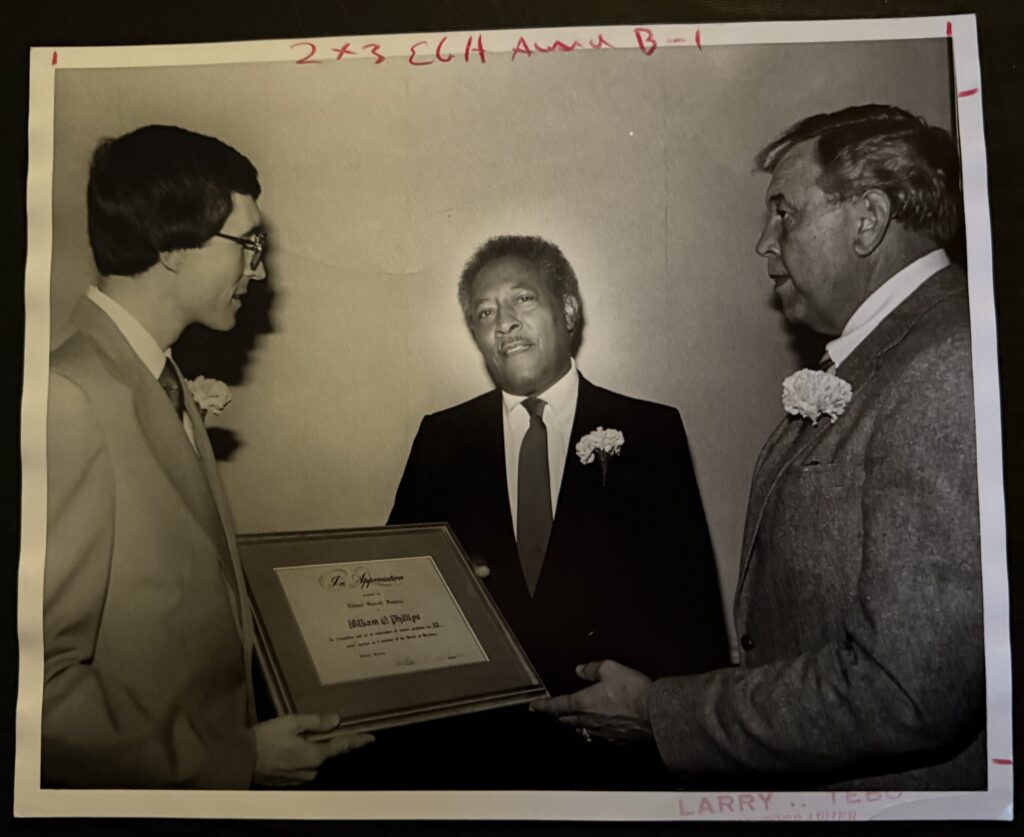
In 2005, Phillips received the United Way’s Arthur J. Decio Award as Volunteer of the Year.
Phillips’ lifelong work was recognized with honors from Black Expo and the Urban League. He received the Lewis S. Armstrong Award for Business and Economics by IUSB.
“Elkhart has been good to me and my family and I have always felt I should do something to make the community a better place to live,” Phillips said in November 1999.
Love for community
Even in retirement, Phillips kept a keen eye on the local situation.
“There are still employers in Elkhart and Elkhart County that don’t have many blacks,” Phillips said in a 1999 article, tying the problem to insufficient educational opportunities. “No one will give them a chance at the entry level, and that’s so important. Until we get people in at the entry level, the glass ceiling has no effect.”
When Bill Phillips died Oct. 27, 2012, Elkhart Mayor Dick Moore, a Democrat, remembered the Republican councilman as a “great community contributor.”
“He was very broad-minded, very open-minded about things,” Moore told Truth reporter Dan Spalding. “Bill recognized when somebody was doing a job – and doing it well – regardless of the politics.
“He was one of those guys they’d like to have in Washington today (who could) come to the middle of the road and talk to anybody.”
Bill’s son, Kerry, said, “My father was receptive to people based on just their character, and to that extent, he didn’t care about race. I was always amazed at how much my father really loved this community. …
“I was always proud of him, how he carried himself and the concern he showed for the community and his willingness and eagerness to work in the community in so many capacities geared toward making Elkhart a better place.”