
Ten Commandments and four years debating the First Amendment
The unveiling of the Ten Commandments monument at Elkhart’s city hall was worth a headline at the top of the following day’s newspaper.
For 40 years of days and 40 years of nights, the granite slab stood in its quiet, informative way, not too far to the right of city hall’s front door. At some point, decades of unattended landscaping started to obscure parts of the stone.
Then, a clap of thunder caused by the collision of religion and government brought Elkhart a four-year storm of constitutional dilemma.
Courts gave muddled guidance.
Legal bills rolled up.
And a community engaged in strong – yet peaceful – debate about the meaning of the First Amendment.
That last part is something the people organizing the monument’s dedication in 1958 saw coming … but hoped could be avoided.
“Americans have inherited moral power from the founding fathers of our country,” the Rev. W.W. Kenhell, president of the Elkhart Ministerial Association, was reported to have said that day. “And if they will accept the precepts of the Ten Commandments, it will provide their redemption from today’s strife and tears.”
Making a case …
In the spring of 1998, the Indiana Civil Liberties Union filed a lawsuit against the city of Elkhart. Two men claimed the monument in front of city hall – with a line announcing, “I am the LORD thy God” – violated the First Amendment’s Establishment Clause.
The community responded swiftly.
“Not only do I believe that this monument should remain in its current location,” city attorney Paul Eash said, “I endorse the 10 points inscribed here.”
“I don’t understand why people get so upset at the Ten Commandments,” said the Rev. Dick Kallenberg of St. John the Evangelist Church. “They really are the basic laws of human civility.”
“Civil liberties throughout the state of Indiana must be in astonishingly good health,” Larry Murphy proclaimed in his Elkhart Truth editorial about the ICLU on April 28, 1998. “… These stalwart defenders of fundamental American rights must have concluded that no one in this state is suffering from discrimination, no one’s speech is being stifled, no one’s vote is threatened, no one’s trial has been unfair. What a wonderful state, where the worst threat to liberty is a rock!”
Richard Leib, a business owner and Truth columnist, wrote in a letter to the editor, “I would like to point out to the ACLU that right beside the monument is nothing – just a big empty space. So, perhaps, those atheists that are bothered by the commandments should simply look at the empty space, which represents their beliefs.”
… and weighing the law
It was a lightning-fast response in defense of a monument few recognized existed in its spot. But that’s not to say 100 percent of the community stood firm that government property was an appropriate place for this monument.
“(S)ome argue … the Ten Commandments are a guiding principle of justice that is pertinent to our legal system,” wrote Kyle Hannon, a Truth columnist and future city councilman and Greater Elkhart Chamber of Commerce president. “Fine. And I’ll bet there are other worthy statements appearing in The Koran, The Talmud, The Book of Mormon and the writings of Scientology. If you include those writings then you have the kind of open display that might pass Supreme Court scrutiny. If you exclude those other writings, then you are endorsing one type of religion over another.
“It’s the idea of government and religion walking hand in hand that gets troublesome.”
Eash presented a resolution to the city council in defense of the stone. “It is a historic monument, designed so not to offend anyone,” the attorney told The Truth’s Rick Meyer for an article on May 5, 2001. “It’s not on an intrusive location. It doesn’t force people to see it.”
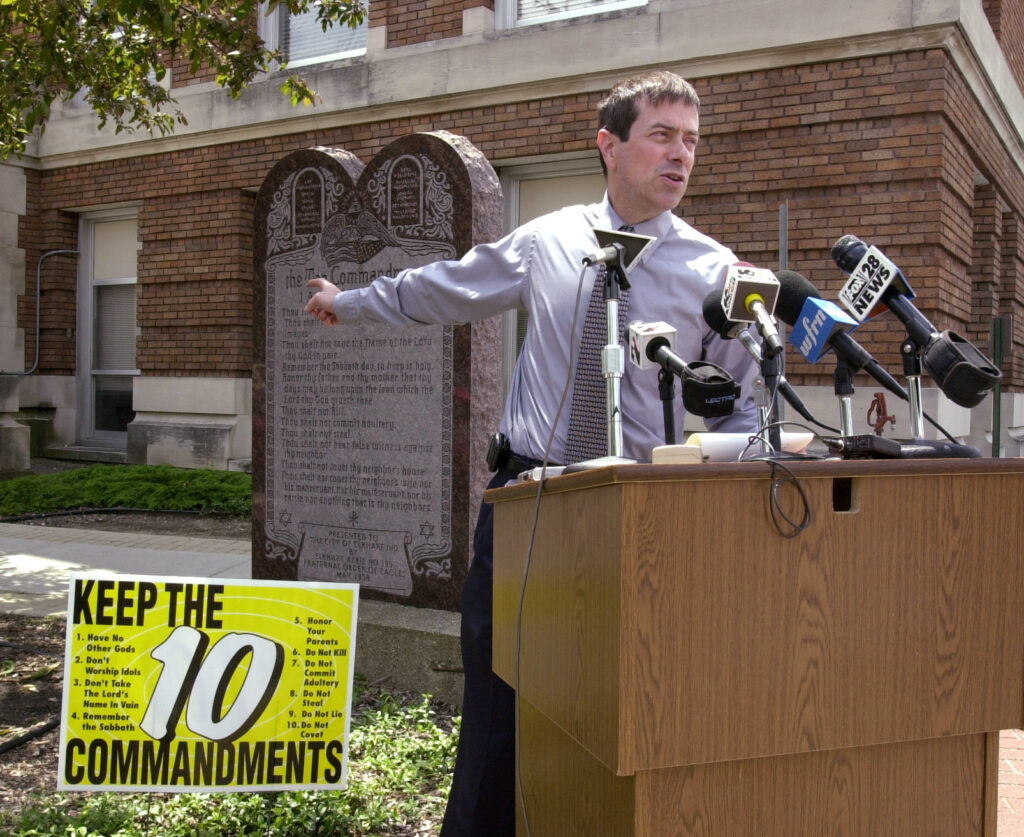
The measure passed 8-1, with Ellen Krulewitch dissenting. “It’s not whether we believe in God,” she said. “It’s whether the monument is appropriately situated on city property.”
This was the heightened level of commentary and action just 10 days after the ICLU asked the city to move the stone.
Only four years to go.
Renewed faith
In the decade after World War II, the nation collectively considered its moral standing. The horrors of the Nazi regime. The consequences of the atomic bomb. The divisions caused by segregation. Americans had plenty of chances to be self-reflecting.
Many turned to their faith to show the way forward.
From the East Front of the Capitol, President Dwight Eisenhower opened his 1953 inaugural address with a prayer.
“Give us, we pray, the power to discern clearly right from wrong, and allow all our words and actions to be governed thereby, and by the laws of this land,” Eisenhower said. “Especially, we pray that our concern shall be for all the people, regardless of station, race or calling.
“May cooperation be permitted and be the mutual aim of those who, under the concepts of our Constitution, hold to differing political faiths; so that all may work for the good of our beloved country and Thy glory.”
A Minnesota judge already had been working to refocus offenders on right versus wrong. E.J. Ruegemer started a movement with a simple decision in his courtroom during a 1946 case. Instead of sentencing a young man to jail for stealing a car, he instead ordered him to learn the Ten Commandments.
Hollywood calling
As a member of the Fraternal Order of Eagles, Judge Ruegemer sought a wider scale distribution of the Commandments as fliers to public places, churches and youth organizations, according to a 2001 Wall Street Journal article. The judge eventually pressed the service club to install copies in courtrooms and schools.
Famed filmmaker Cecil B. DeMille, ready to release his big-screen epic about the Decalogue, saw this as an opportunity to create lasting displays. Stars of the movie, including Charlton Heston, appeared around the country with Eagles groups. They unveiled countless granite monuments listing the Ten Commandments.
On the Friday following Memorial Day 1958, the larger of the two available sizes was installed outside Elkhart’s city hall.
Robert Long, the city controller, accepted the monument on behalf of Mayor E.L. Danielson. Local officers with the Eagles joined Catholic and Protestant leaders and a Jewish rabbi. They proclaimed “the monolith … should serve as a reminder of God’s laws to the hearts and minds of all who see it,” according to The Elkhart Truth report on May 31 that year.
The status given to Rabbi M.E. Finkelstein of Temple Israel at the Elkhart unveiling was not accidental.
Invited with purpose
In the 2001 Wall Street Journal article sparked by the legal fight in Elkhart, reporter Jess Bravin wrote about a complaint received in Minnesota 40-some years before about a monument being placed on public property.
“When a Minneapolis rabbi protested that the project ‘represents a serious threat to … the classic American principle of separation of Church and State,’ Judge Ruegemer sought advice from Paramount (Studios),” Bravin wrote. “Jewish concerns posed ‘a serious and very delicate problem,’ responded the late DeMille publicist Donald Hayne in a letter to Ruegemer.
“Among other ideas, he advised lining up, in each town, the local Protestant, Catholic and civic authorities and then hoping that the local Jewish group may not choose to stand out against the majority opinion. The plan may have worked in Elkhart …”
The Establishment Clause confirms government neutrality on the issue of religion. Government can neither prefer one religion over another nor favor religion over non-religion.
The 1958 dedication addressed private concerns about the First Amendment issue. The 1998 lawsuit brought other perspectives into the public conversation.
Split decisions
Michael Suetkamp, an atheist, joined the ICLU lawsuit with plaintiff William Books. “Often people are quick to forget that whatever rights they enjoy are enjoyed equally by others as well,” he told The Truth’s Nancy Bounds in a May 2001 email. “They don’t seem to understand that the rest of us enjoy the same freedom of conviction that allowed them to make their decision of conscience.
“We will just have to keep reminding them.”
The two sides split the opening decisions.
Judge Allen Sharp of U.S. District Court in South Bend favored the city’s defense. A divided Seventh Circuit Court of Appeals declared the ICLU was right and the monument’s placement violated the Establishment Clause.
In the spring of 2001, the eyes of the nation were on Elkhart. The Supreme Court weighed whether to hear the case.
“I think it will encourage more people to pray,” Mayor Dave Miller said in The Truth on March 10, 2001. “… It will remind people that their religious freedoms are not immune from attack.”
The 700 Club, a syndicated television talk show appealing to the Christian perspective, interviewed breakfast goers at Old Style Deli and the Daily Grind. Conservative political commentator William F. Buckley wrote about the case in National Review. Dr. Laura Schlessinger told her 18 million daily radio listeners to sign petitions to support Elkhart and organize in their home communities.
“I’m delighted to have someone with (Schlessinger’s) prestige and notoriety speaking out in defense of our efforts to save the Ten Commandments monument,” the mayor said. “… (J)ustices on the Supreme Court read papers, listen to radios and have friends, too. There’s every opportunity they may be warmed to our effort because of the publicity.”
No more arguments
The case wouldn’t be decided on public opinion, though. In fact, the case wouldn’t be definitively decided at all.
At the end of May 2001, the Supreme Court announced it would not hear arguments.
In a rare turn, Chief Justice William Rehnquist authored a statement about why the court should have accepted the case. Justices Clarence Thomas and Antonin Scalia agreed. Noting the depiction of Moses holding the Ten Commandments in their own courtroom, Rehnquist indicated the time was right to consider whether the Decalogue was permissible due to historical and cultural significance.
Justice John Paul Stevens admonished his colleagues and Elkhart leaders in their attempt to redefine the monument’s secular purpose.
“The graphic emphasis placed on those first lines is rather hard to square with the proposition that the monument expresses no particular religious preference,” Stevens wrote. “… All three (speakers at the 1958 dedication) spoke not of the ‘cross-cultural … significance’ of the Ten Commandments, but of the need for every citizen to adopt their precepts so as to obtain ‘redemption from today’s strife and fear.’ To dismiss that history in favor of a resolution issued by the Elkhart Common Council on the eve of litigation is puzzling indeed.”
The Supreme Court’s move ultimately put the issue back in Sharp’s district court for further consideration.
Costly defense
“Clearly,” The Elkhart Truth editorial stated on May 30, 2001, “most people in the Elkhart community want to keep the monument in its place at the Municipal Building where it stood without complaints for 40 years. … Although judicial opinions are muddled, a way can be found for the monument to stay.”
The Miller administration proposed adding four more monuments with historic texts. Cases in other locales with various circumstances crowded into the judicial circle, giving Sharp plenty to consider.
“I pledge my commitment to the end to preserve not only the granite monument’s place in our city, but also the Ten Commandments’ place in our hearts,” Miller declared in his July 2001 State of the City address. “In my opinion, there is no place in the City with a Heart where the Ten Commandments do not belong.”
The judge eventually decided in May 2002 the remedy would not be acceptable. He also ruled it was time for the city to pay more than $60,000 in legal reimbursement to the ICLU. Miller said the ruling “really took the wind out of our sails.”
City leaders announced the monument’s relocation to private property on North Main Street at the river. “It was a very easy decision,” said Brian Buckley, vice president of land donor Banks Corp.
“If our religious liberties are going to be preserved,” Mayor Miller told The Truth, “we will need new judges to defend them. And the prospects for that happening soon are dismal.”
But several families in Elkhart responded to these developments with action of their own.
‘Last hill on the prairie’
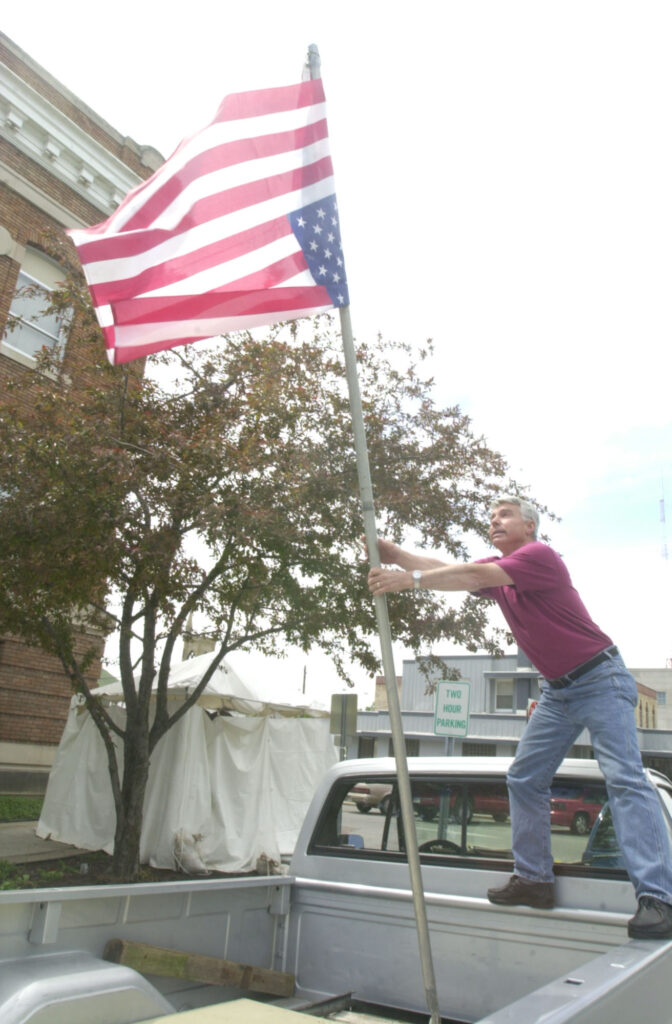
Bob Weaver and Jim Bontrager took the lead. They raised funds, organized vigils, and acted as spokesmen for the citizen movement. Wendell Norwood flew an upside-down U.S. flag from his parked truck outside city hall. Groups large and small showed their support at the monument.
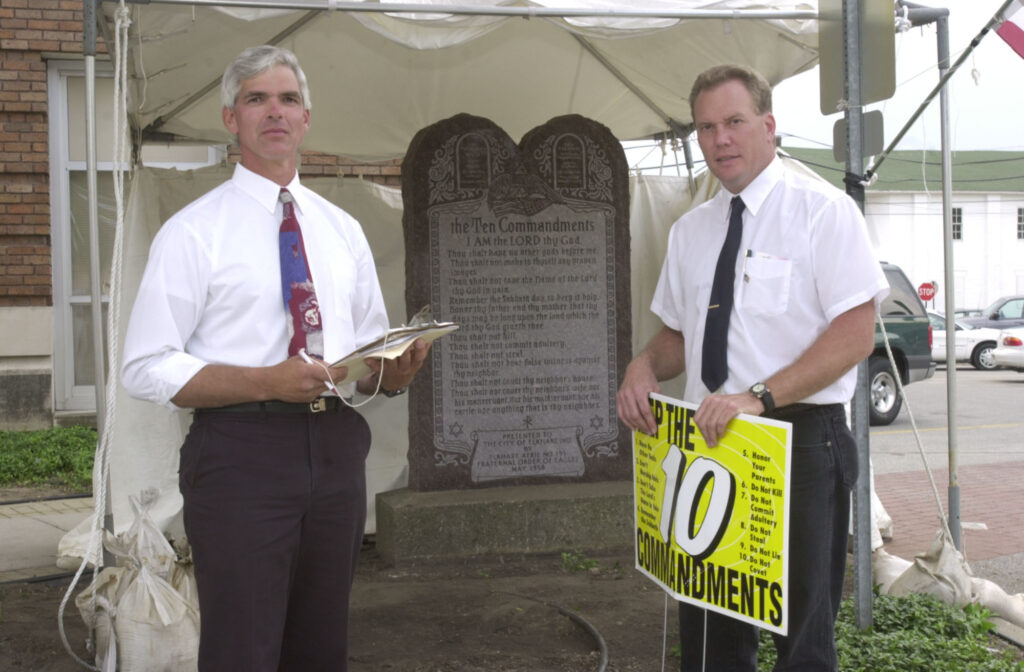
In just a few weeks, Bontrager said, donors contributed $40,000 to a community legal defense fund. They took steps to form a political action committee. And then they asked Judge Sharp to enter the case as a defendant.
“We’ve lost on so many fronts what is good and right in America,” Weaver, the son of former Mayor John Weaver, told The Truth for a May 29, 2002, article. “I look around and this seems like the last hill on the prairie.”
The group put together a full-page newspaper ad as a call to action. “Judicial activism is destroying this nation. … Friends, the problem is no longer ‘out there.’ It’s in our community and as stewards of freedom will we baulk at Our responsibility to peacefully stand for truth?”
While his administration made plans for moving the stone, Miller was grateful to the group for their efforts. He offered to give them time to organize, but he said he couldn’t risk more taxpayer money.
“If the supporters of the Ten Commandments are successful in entering the case … more power to them. I support their efforts,” Miller said. “… and appreciate the respect they’ve shown me by not insisting I expend any more of the city’s resources.”
‘All of heaven was crying’
Truth editors, though, were cutting bait after four years of support.
“(T)he move has been delayed. The holdup is unfortunate. It prolongs a controversy that has run its course and should be concluded,” editorial page editor Larry Murphy wrote on June 4, 2002. “Those who want to continue the court battle seem to be saying two different things – that the monument should stay as a civic endorsement of religion, and that it can stay constitutionally because its purpose is predominantly secular. Both things can’t be true at once.”
Local faith leaders shared their varying views with The Truth. Pastor Michael Muccio of Elkhart Christian Center offered, “It’s really ridiculous to have to cower to a few people’s opinions.” Pastor David Bibbee of Elkhart City Church of the Brethren said, “My faith is not tied up in pieces of granite. It’s not an external object to us. It’s something that we live out in our own lives.”
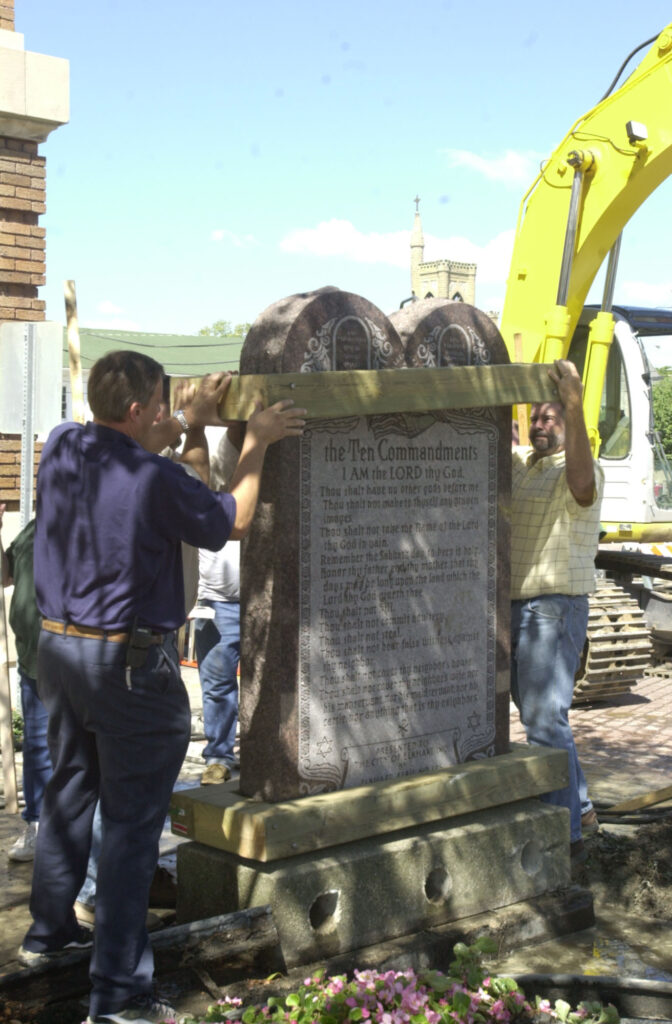
On Aug. 8, 2002, workers spent three careful hours cutting the monument from its 7-foot base. Truth reporter Terry Mark described the scene: “A few minutes after all the workers had left Thursday morning, taking the Ten Commandments monument with them, an elderly woman walked to the front of city hall wiping away tears. Staring glumly at the muddy flower bed where the monument had stood since 1958, the woman declared that ‘all of heaven was crying.’”
A week later, Judge Sharp declared the lawsuit over. He would consider no more arguments.
A time for renewal
About 200 people came to Main Street in late September 2002 to witness a rededication of the Ten Commandments.
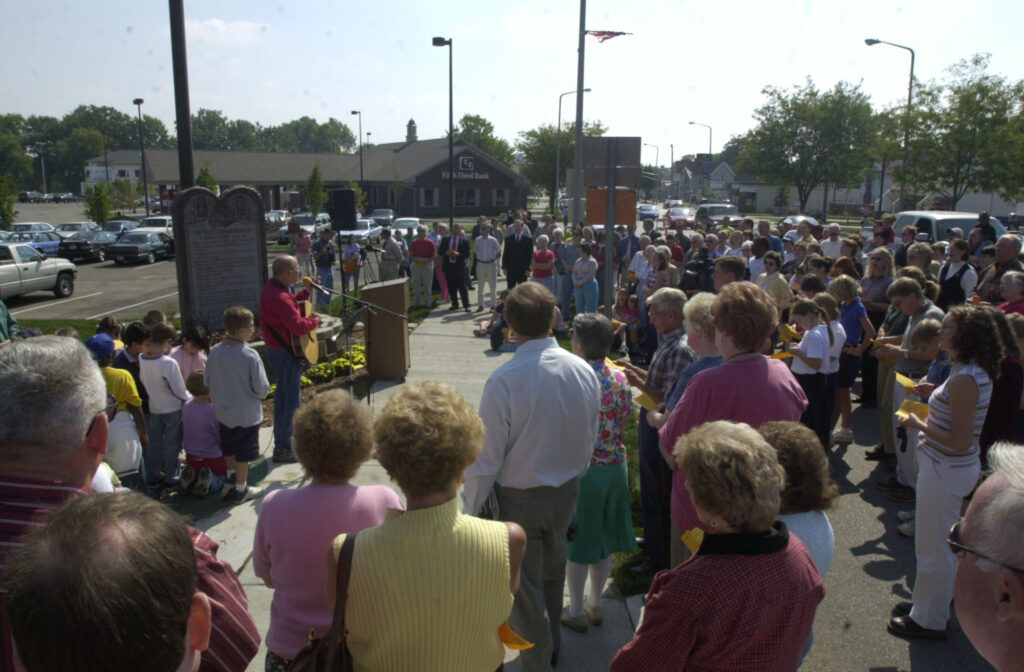
“Today, we’re here to celebrate God’s word, God’s commandments, which are posted at the gateway of our city,” announced Pastor Scott Tuttle of River of Life Church. “… This wasn’t just a Charlton Heston movie. This is real life. I’m here to tell you today these laws are still relevant to you and I in 2002.”
Workers from the city’s street and parks departments had finished installation of the Ten Commandments the week before. The Truth’s Terry Mark reported drivers in the 400 block of Main saw a sign noting, “Slow. God at Work.”
During the rededication, the Rev. Donnell Brown of Agape Missionary Baptist Church led those attending in reciting the commandments. “We need to know them in our hearts,” Brown said, “so we can live them together.”
Interpretations
The Ten Commandments monument stood again, though moved from the city’s public property. Debate on the overall issue has not ended.
In 2003, Weaver and Bontrager succeeded in leading officials to install a famed copy of the Commandments alongside reprints of other historic documents at the Elkhart County Administration Building in Goshen. At least two governors have attempted to have a monument placed on the statehouse grounds in Indianapolis. Most recently, a state lawmaker introduced a bill to have the Ten Commandments posted in public schools.
Supreme Court justices charted a new path in 2022 for interpreting the First Amendment. Abandoning the long-held legal “test” for the Establishment Clause, as was used in the Elkhart case, justices determined history and traditions must be given due consideration.
One of the first statements by Weaver’s group, made in a newspaper ad May 15, 2002, appealed to tradition.
“Our forefathers founded this nation upon the Christian faith and it will live so long as the Lord is our God. … We must return to the faith of our fathers,” according to the advertisement placed by the families of Weaver and Jeffrey Schaffer, along with “our friends who share our faith.” The ad continued, “The choice is clear. It is repent or perish, revival or ruin, Christ or chaos.”
John Krull, executive director of the Indiana Civil Liberties Union, also staked a claim rooted in history. At the height of the Elkhart debate in May 2001, he told The Truth, “We feel that our take on this was drafted and spread by James Madison when the Founding Fathers made the First Amendment. The Bill of Rights isn’t up for popular vote.”