
Got a minute? Favorite Hoosier pastime happens around the clock
What time is it in Elkhart, Indiana?
The factual answer can be simple. Well, most of the time. Maybe not so much in 1967, when City Hall had a single, law-abiding clock showing one hour later than the time everybody knew on the street.
Daylight or standard. Eastern or Central. Elkhart and all of Indiana have spent plenty of time debating time.
“Indiana is in a bad spot in the middle of the intersection,” State Rep. Richard Shank, R-Elkhart, said in October 1987. Eighteen years before that, Elkhart Mayor John Weaver said, “I don’t much care anymore; I just wish they’d get the thing settled.”
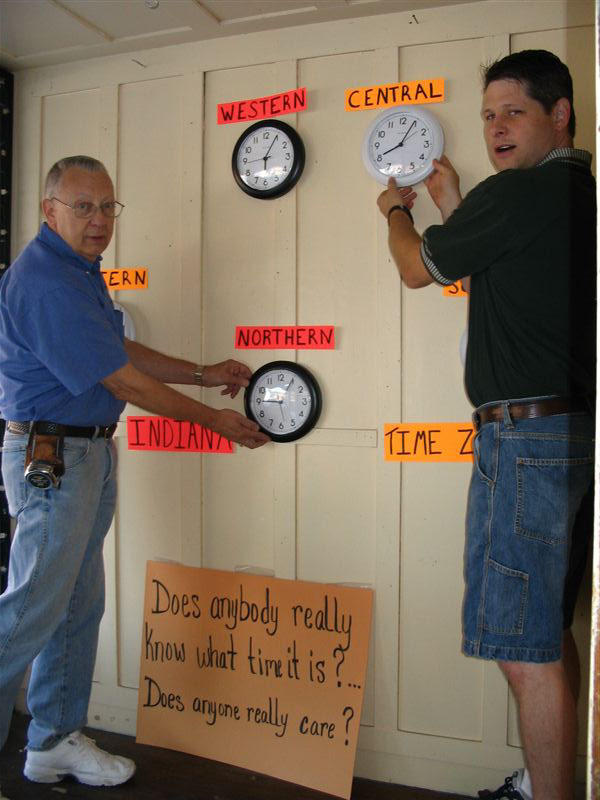
After Gov. Mitch Daniels successfully brought daylight saving time to Indiana in 2005, Pro-Hardware in Wakarusa decorated the storefront windows with clocks and a sign with the classic Chicago lyric, “Does anybody really know what time it is?” Store manager Curtis Jones said, “We’ll have to run a sale on light bulbs to get rid of them. Nobody will need them with all this daylight we’re getting.”
Earlier that year, in the heat of the debate, The Elkhart Truth printed five “fast facts” about daylight saving time on its front page.
No. 5? “Each day will continue to be 24 hours long.”
So what time is it in Elkhart, Indiana? The argument spans generations. And elected officials here were pivotal players in how we set the clocks today.
‘Unhealthy for cows’
Got a minute?
After World War II, all of Indiana technically observed Central Standard Time year-round. Yes, according to the Indianapolis Star, state lawmakers really did reject daylight saving time as “unnatural” and “unhealthy for cows.”
Congress passed the Uniform Time Act in the mid-1960s to establish national expectations. But the law arrived with weak enforcement and wide loopholes for communities to still set their own clocks.
The Indiana General Assembly rejected the federal decision for its “detrimental effect on the business and economy of the state … and on the convenience of its citizens, who have become oriented to practices regarding time which best meet the requirements and desires of each locality …”
Then split by time zones, Elkhart and South Bend finally shared the same time in April 1967. St. Joseph County residents moved clocks ahead for Central Daylight Time, while Elkhart spurned the federal government’s demands and stayed put on Eastern Standard.
“(A) 1967 law of the Indiana General Assembly forbids Elkhart from doing this,” Truth reporter Sam Mercantini wrote, “but does mandate that the federal time should be shown on a clock in every public building in the county.”
So, one dial in City Hall ran an hour fast.
‘Uniform as a hillside cornfield’
The U.S. Department of Transportation proposed putting St. Joseph County and all but the western corners of the state on Eastern Time. After a year of inaction, The Truth’s editorial page took on the issue in early 1969. “Elkhart and St. Joseph Counties belong in the same time zone the year around. That should be a first principle of any time zoning decision,” editors wrote.
Broadcasters sued the government to compel Indiana to observe Eastern Daylight Time. Drive-in theater owners sued to keep Central Standard Time. To the north, Michigan voters defeated “fast time” by 490 votes out of 2.8 million cast in the referendum. Mayor Weaver was fed up, as were lots of people.
Elkhart Truth reporter Bettie East wrote each person should be able to “observe the time which he thinks best conforms to his particular living pattern. … The store, factory or other business owner would set his own business hours. … If (the employee) follows his own, it would be hoped that his hours would conform with the owner’s, particularly in respect to times for appearing to pick up pay checks.”
Her article appeared on April Fool’s Day 1969.
In the 1980s, columnist Jim McNeile reflected on time after his journey into The Truth archives. “For Indiana,” he wrote, “situated in the middle of two time zones, it was about as uniform as a hillside cornfield.”
Back and forth
Got another minute?
With shifting time boundaries, South Bend moved clocks two hours ahead in 1969.
“Resourceful Hoosiers hit upon a way to patch their time together,” the Associated Press reported. “Each spring, mayors, city councils and county commissioners watched each other until, by informal or unofficial agreement, they learned what the majority of their neighbors planned to do for the summer and followed suit.”
The head nods and shakes did not go unnoticed by The Truth editorial board.
“It was rather startling to have the city of Elkhart and the Board of County Commissioners agree on at least one thing – that they would obey the law and follow Eastern Daylight Time beginning Sunday,” editors wrote in the April 24, 1969, editorial. “Too bad the agreement had to come with a federal gun at their heads. Too bad they can’t work together on things that could be settled and done here and now – before they are forced to coexist and to solve matters long since out of control. Too bad.”
Come 1970, Michigan was an hour behind Indiana. The next year, the General Assembly sent Indiana back to standard time. In 1972, Congress fixed the Uniform Time Law to give the western corners of Indiana the chance to follow neighboring states with daylight time.
Then, Middle East oil embargoes started a national energy crisis. Congress put the country on DST as a conservation move, but those changes were on-again, off-again too.
TV guides the time
Truth reporters kept it all straight for readers with one reference point.
Reporter T.J. Hemlinger wrote about what time Captain Kangaroo and Johnny Carson would air on TV in Elkhart starting in April 1978. For the non-time change in 1988, David Schreiber wrote for “those diehard fans of ‘Santa Barbara’ … read carefully and you will not have to miss the big event, the wedding of Eden and Cruz.” In 1992, it was all about Powerball drawing times and the “Hoosier Millionaire” lottery show.
The television struggle was real.
Reporter Bil Harp, interviewing WSJV-TV’s Martha Sims in April 1987, wrote, “Monday through Friday, we lose an hour in the middle of the day, she says. That may sound impossible, but to a television programmer it is perhaps a surreal sounding nightmare. It has something to do with the number of network ‘feeds’ the station gets. … But it also means that fans of ‘Fame Fortune and Romance’ and ‘Webster’ (and Sims insists there are some) won’t be seeing their favorites any more until fall.”
McNeile’s reflections on time led him to recall “(l)etters to the editor in those days were passionate, full of scriptures about ‘God’s time’ or references to history with ‘war time,’ ‘victory time,’ ‘farmer’s time.’” He even located what he said was the best letter to the editor.
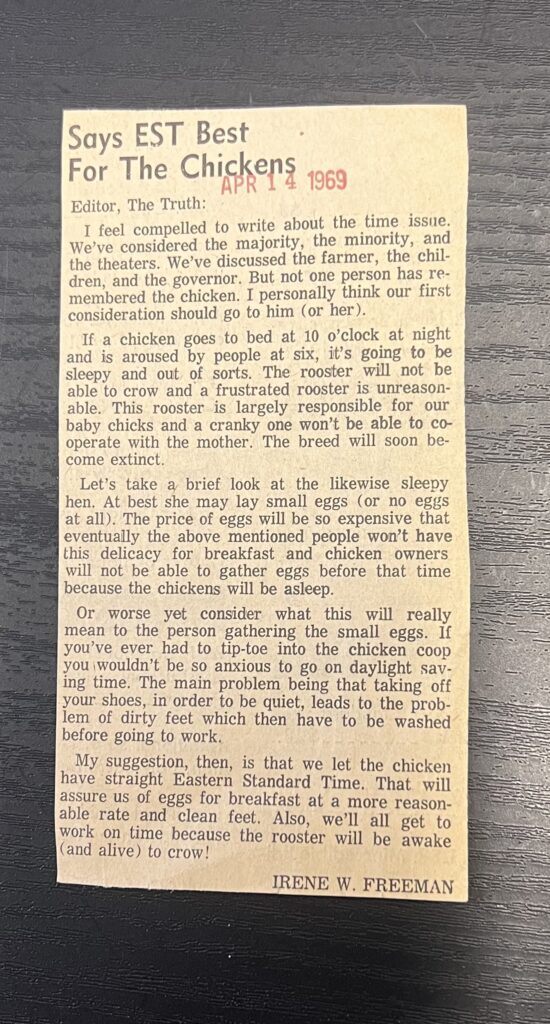
But it was finally time for business leaders to take their stand.
Time, after all, is money
At the beginning of the 21st century, Indiana leaders said it was time to catch up to the rest of the world. Gov. Mitch Daniels gets credit for making daylight saving the law, but the political conversation started with Gov. Frank O’Bannon.
During his Jan. 23, 2001, State of the State address, the Democrat stopped for applause on 25 different lines of his speech, according to the report by Mike Smith of the Associated Press. “(B)ut with one simple sentence, he also managed to incite grumbles. That statement was this: ‘And let’s pass daylight-saving time to help Indiana compete.”
A divided voting public kept the issue from taking off. Rep. Craig Fry, D-Mishawaka, said he’d refuse to give the governor’s proposal a hearing if a bill came to his House Commerce Committee.
The Hoosier Daylight Coalition already had spent $500,000 on promoting change. Ken Frey, owner of Goshen manufacturer American Cargo, said, “Everybody else runs on daylight savings time, so they figure our sales people should be in the office and ready to go.” Engineer Burne Miller told lawmakers attending a Chamber meeting, “It’s light out at 5 o’clock in the morning during the summer. For what purpose? … It’s time we get our heads out of the sand on this one.”
Indiana University economist Morton Marcus was unmoved. “Now we are to believe that people who understand nanoseconds are discombobulated by Hoosier time,” he said. “Entrepreneurs who operate around the world, around the clock, are seemingly so sensitive that they are confounded by our time.”
Forward progress
So, daylight saving lingered in the background until Daniels gave it a two-handed shove. “If it were just a matter of the rest of the world laughing at us, I’d say let ‘em laugh. But the loss of Hoosier jobs and incomes is no laughing matter, and any step that might help is worth trying,” the newly inaugurated leader said in January 2005.

Daniels took over a state with a $600 million deficit. He wanted to sell the Toll Road, privatize services, and reduce bureaucracy. “We need to get lean and mean, back to the basics,” Elkhart City Council president Jim Pettit said in support of his party’s governor. “He’s encouraging local governments to be more involved in directing their future.”
The General Assembly remained skeptical about making the leap on time. “I can raise taxes 10 times and not generate as much heat as this issue,” Rep. Dale Grubb, D-Covington, told the AP in February. “When the rest of the world changes, we need to change with them,” Rep. Jerry Torr, R-Carmel, argued.
Daniels did not back down, and Elkhart County’s legislative delegation entered the spotlight.
The clock nearly stops
Helen Zimmerman kicked off the 2005 legislative season with a shot across the bow in her Jan. 15 letter to the Truth editor.
“Good old Hoosier common sense points to this subject as having become a political ploy,” she wrote from Elkhart County. “… What is wrong with Indiana being an individual state catering to its Hoosiers? Businesses and recreation cater to changing hours individually all year.”
The legislation was limping through the process but surviving. State Rep. Jackie Walorski, R-Lakeville, stated her opposition to the change. But conflicting meeting schedules caused her to miss a vote that would have killed the bill in committee.
In a Feb. 18, 2005, editorial, The Truth’s Stephanie Gattman reported on her conversation with Walorski. “… (A)fter 40 years of debate and argument over DST, there is no way legislators can convince constituents of the economic impact in the one week that remains until the final vote in the House, (Walorski) said.”
State Rep. Tim Neese, R-Elkhart, announced his opposition because he didn’t agree time change had “much or any effect on state commerce,” according to reporter Jason McFarley’s Feb. 25 article. State Rep. Craig Fry, D-Mishawaka, said frankly, “Most people just don’t want to change their clocks.”
And John Ulmer, a Goshen attorney and a key vote in Daniels’ Republican majority, told McFarley he, too, would vote no – a fateful announcement.
At a Goshen Chamber of Commerce Forum at the end of February, several businessmen rose to challenge Ulmer on his stance. The chamber’s survey showed two-thirds of members supported “some sort of DST.” Rep. Dave Wolkins, R-Winona Lake, said openly during the session, “I kind of enjoy this, John – you getting beat up.”
… but keeps on ticking
To Helen Zimmerman’s point, this was becoming all about politics. Democrats walked out of the session in early March to protest Daniels’ legislative “power grab,” as described by Minority Leader B. Patrick Bauer, D-South Bend. With the House at a standstill, piles of legislation died.
“Indiana’s drive for growth and reform was car bombed yesterday by the Indiana House minority,” Daniels told the Associated Press on March 3.
State Sen. Marvin Riegsecker, R-Goshen, told The Truth, “It’s obvious the House has failed miserably. … I think we’re all offended because people wanted us to go down a different path than we have been on for a number of years.”
But wait!
In the Indiana General Assembly, there’s always more time.
Riegsecker saves time
On March 30, Gattman announced breaking news in her editorial. Daniels personally asked Riegsecker to revive daylight saving time. “When the governor calls and taps you on the shoulder, that makes the request pretty strong. … You can make all the arguments for all the reasons you want to. The governor is trying to project a new image for the state of Indiana.”
The legislative maneuvers were procedural and technical.
Within days, a House committee endorsed DST with an 8-4 vote.
At a key deadline, the full House voted 50-49 against it. However, final action requires 51 votes.
A second vote that night came to 50-49 in favor … and Daniels’ chief lobbyist on the issue, Speaker Brian Bosma, R-Indianapolis, kept the vote open 10 to 15 minutes past the usual ending time. Rep. Donald Lehe, R-Brookston, put the bill over the top to keep the process moving.
Riegsecker resigned himself to the role of campaigner for daylight saving time. “I think it’s reflective of the next generation’s attitude for how we’re going to do this in terms of time. We are looking at becoming the logistics and distribution center of the country,” he told Gattman for the April 17 editorial.
Bosma replaced an assigned lawmaker when the bill became stuck in conference committee. The Senate Rules committee finally received the agreed bill for review and moved it along with a 6-5 vote … with one of the yeas committing to vote against it on the floor.
This officially became the bill that could not be killed.
‘I felt the need to apologize’
Opinions continued to run hot at home.
“Why don’t they fix the roads or come up with ways to save us money, rather than spend all this time talking about this stupid issue,” Sue Witmer, a “soccer grandma,” told Truth reporter Trevor Wendzonka for the April 28 edition. “I don’t think it’s right to change the clocks. We don’t know what zone we’re going to be in, either, so how do we know how it will affect the state? I think it’s all wrong.”
A day later, time change arrived again in Indiana. The Senate voted 28-22. The House again needed two votes to get to the magic number 51. Members cheered wildly when the yeas prevailed.
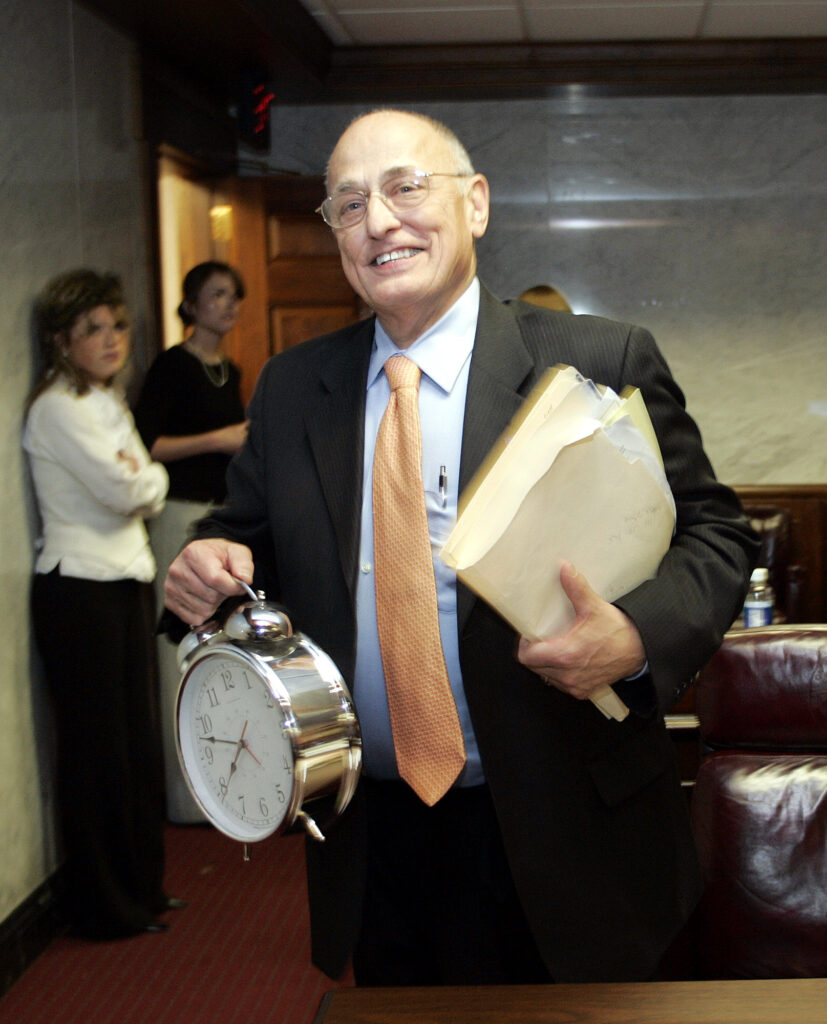
Goshen’s Riegsecker carried the bill across the line. Goshen’s Ulmer changed his vote from no to yes on the final tally.
According to Wendzonka’s post-session wrap up, Daniels told Ulmer, “If I can ever do anything to help, let me know.” Riegsecker said he asked for nothing, but hoped his support would elevate Elkhart County in the governor’s view.
Ulmer said, “In my statement after the vote, I felt the need to apologize (to the district). My word is my bond, and I said I wasn’t going to vote for it, but I’d learned some new things. Besides, what the Democrats were doing was wrong. Four of them supported (the bill) all along but weren’t voting for it. They were making it a partisan issue.”
The representative said he was convinced by business leaders who told him about scheduling problems, about saving millions of barrels of oil each day, and about becoming more efficient. “And what it all comes down to,” he said, “is keeping jobs in Indiana.”
The newspaper weighs in
The 2005 debate lit a fire on The Truth’s op-ed pages, stoked by Gattman’s frequent reporting and writing. It was a significantly louder stance than the newspaper had ever taken on the issue. But it wasn’t the first time the company attempted to weigh in.
The Truth’s parent company, Federated Media, invested in efforts to keep all hands off the clocks in the mid-1980s.
Owner John F. Dille III served as chair of the radio board for the National Association of Broadcasters. The company donated to the Television and Radio Political Action Committee.
“In doing so,” TARPAC chair Bill Turner wrote to Dille in January 1984, “you have made your voice heard and provided the leadership that is necessary to make the broadcasting industry more prominent and visible in Washington, D.C.”
NAB’s long list of issues during the decade concerned industry deregulation, market ownership, and First Amendment concerns, particularly in advertising.
As Congress looked to extend daylight saving time in 1985-86, broadcasters took issue. Any changes would require changes in power output for stations operating on the AM dial.
Reach, after all, means revenue.
Lobbying by letter
“The proposed legislation would seriously impact on radio broadcasters,” Dille and Edward O. Fritz, NAB president, wrote on March 12, 1986, to U.S. Sen. John C. Danforth, R-Mo., head of the Commerce Committee. “… (The Federal Communications Commission) has struck a delicate balance between various classes of AM stations. This involves the use of directional antennas, reduced power levels, and daytime only stations. …
“(A)ny change in daylight savings time may well affect and disrupt the balancing of interests among AM radio broadcasters.”
More letters were sent, according to acknowledgements located in Dille’s files.
Sen. Howell Heflin, D-Ala., received a short and more personal note to oppose legislation. Al Gore, D-Tenn., who personally signed his reply, stated he was troubled by the potential negative impact of a change on farmers and school children. John Glenn, D-Ohio, sent a cordial if standardized reply, stating his support for the bill.
“The Department of Transportation reports that, when Daylight Savings Time was extended in the early 1970’s,” Glenn wrote, “an estimated 100,000 barrels of oil were saved every day, ninety-six traffic fatalities were avoided, and automobile damage was reduced by $52 million. … While not everyone is completely satisfied with the result, I feel it fairly accounts for the legitimate concerns of both proponents and opponents.”
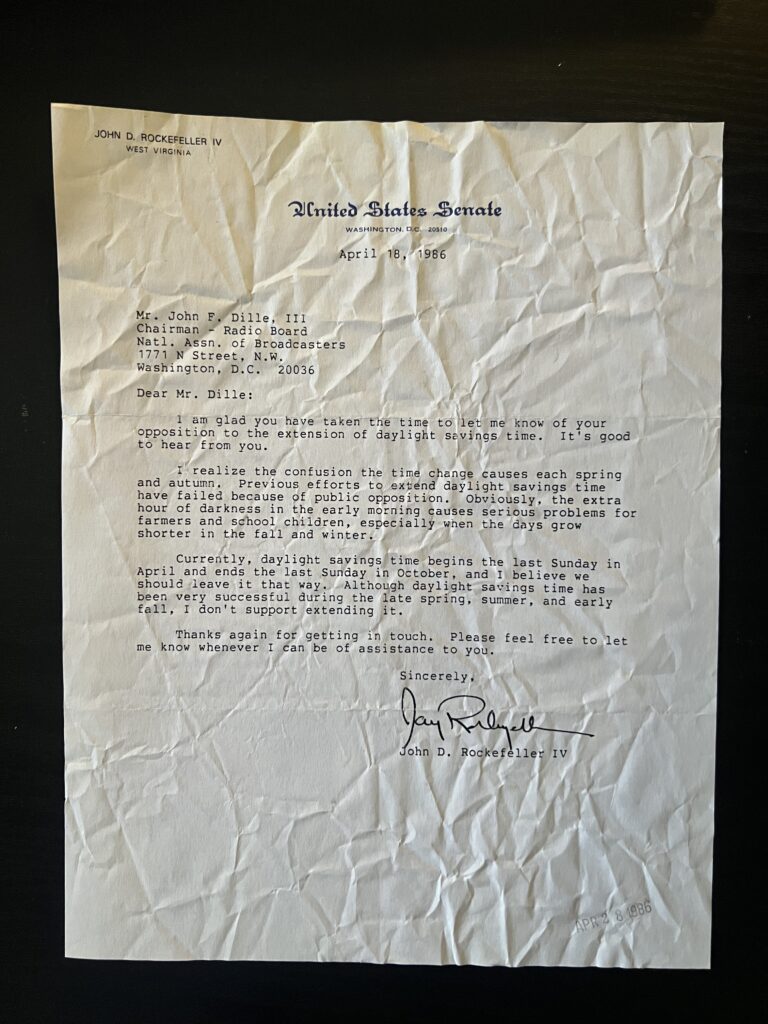
And Dille received a reply in spring 1986 from Sen. John D. “Jay” Rockefeller IV, D-W. Va. Actually, two of them – one dated April 2, the other April 16. Word after word, the letters are exactly the same.
The second letter has all the signs of having been crumpled into a ball, then flattened back out for the file.
Time for opinions, like it or not
On May 1, 2005, Gattman published its first clip-and-save coupon on the editorial page with how lawmakers voted on daylight time. The Truth had argued state leaders had not made the case to change the clocks.
But the newspaper wasn’t quite done with the fighting words. After all …Central or Eastern time?
“Elkhart County will look foolish sitting on the sidelines when it’s so obvious we should be on Central time,” Gattman wrote in her editorial Aug. 14, 2005. “… The case can be made. The commissioners just don’t want to make it.”
But no elected official in the region wanted to have to make the case. At every level, they were unanimous on only one point. They simply didn’t want to have to take up the time controversy.
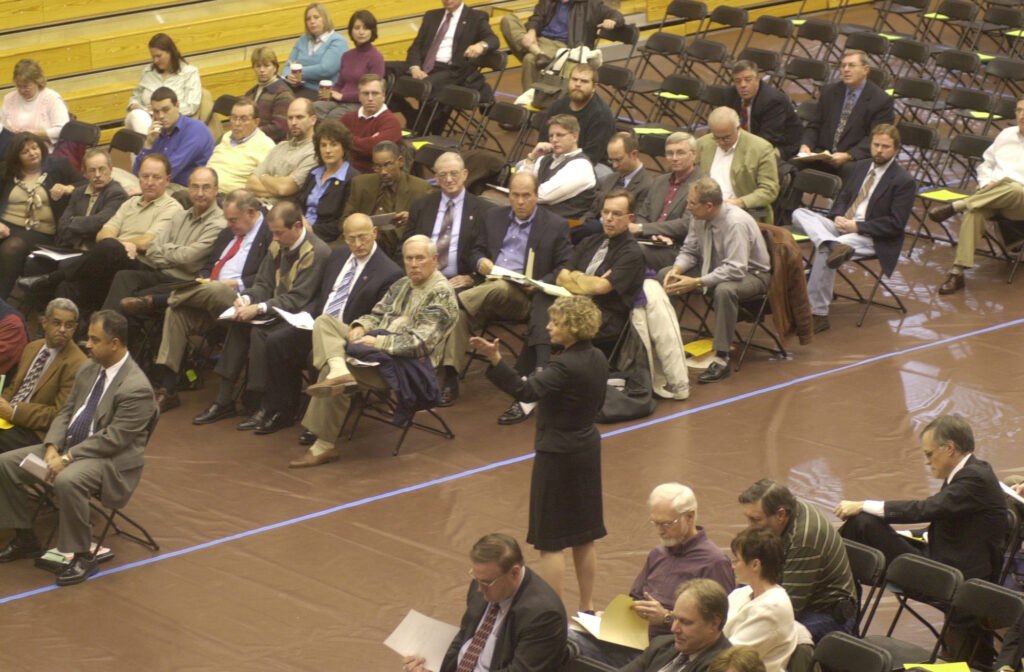
Ultimately, the U.S. Department of Transportation had the final say on where to draw the time line. And while the feds conducted public hearings, they were not to be moved by public opinion. USDOT criteria included business shipping routes, media market maps, commuter patterns, and locations of places for worship, education and healthcare.
But those are facts. Opinions are time immemorial.
Choose a side
South Bend Mayor Steve Luecke (May 27 edition): “I’m speaking for what I believe is in the best interests of our businesses and local residents – and I believe my position on Central time is in sync with the majority.”
St. Joseph County commissioner Steve Ross (May 27): “We are the bigger county, and we have our own economic interests to follow.”
Elkhart County commissioner Mike Yoder (May 28): “It’s interesting the people here in Elkhart County want to think regionally, but St. Joe County wants to do what’s best for them. Do we do more business with the cornfields in Illinois or Iowa, or do we ship goods to the vast population in the Eastern time zone?”
Indiana Chamber of Commerce statement (July 31): “Eastern DST provides the opportunity for business gains, increased safety, energy savings and enhanced quality of life. Moving to the Central time zone eliminates those benefits …”
Dick Pletcher, owner of Amish Acres in Nappanee (Oct. 2): “Amish Acres is one of Indiana’s largest tourist attractions and hosts charter bus groups from across the country. All of them think we are on Eastern time. The buses arrive late, we seat people in our theatre late at every performance. … Put Indiana on Eastern time and clear up the confusion and bring Indiana into the United States and out of Brigadoon.”
Truth reporter Jason Schaap opened his Nov. 20 article the only way possible. “Opinions are like time zones,” he wrote. “Everyone has one.”
Clocking in with a decision
Going into winter, State Rep. Jackie Walorski, R-Lakeville, said she’d introduce a bill to repeal daylight saving if the federal government decided to split St. Joe and Elkhart counties. John Zentz, a Marshall County commissioner, said in response, “We’ve gone through four months of hell. I’m not interested in going through this thing again.”
Gov. Daniels re-emerged in late November to say the feds should decline St. Joseph County’s formal petition to be in the Central time zone. “I regret it took so much time and so much noise,” Daniels said at one point in early November.
But in a defense of his first year in office, the governor positioned himself differently in an Associated Press article. “Folks say, ‘Gosh, what controversy in 2005,’ and I say, ‘Yes, and it’s about time, because to me controversy can be called healthy debate, and it was time for Indiana to try some things and debate some big issues as opposed to drifting and declining.”
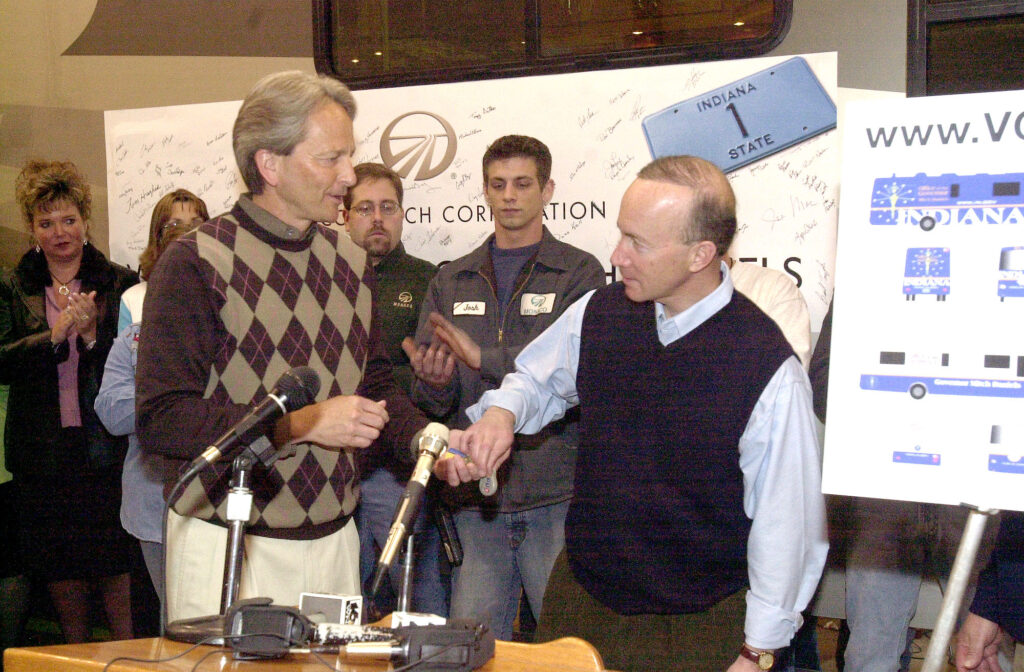
In January 2006, the feds sided with Daniels and Elkhart County leaders and most of the regional business community. The majority of Indiana moved to the Eastern time zone, and in April the Hoosier state’s clocks would move ahead an hour for the first time in decades.
“This effort took more time and energy than anyone ever intended, and I share the feelings of those whose patience was tried along the way,” Daniels said. In the same Jan. 19 Truth article, Mike Yoder told the reporter, “I’m not surprised. I’m hoping that state legislators and county leaders just take a time-out from the time-zone debate.”
The decision came after nearly nine months of debate, 22 hours of public testimony, and 6,000 comments shared on video or via the web.
Time in Elkhart somehow marches on
Not quite ready to let go, Gattman shared another clip-and-save with her editorial April 2, 2006.
“Who can you thank for DST if you like it or if you don’t? We’re providing this handy graphic to remind you. In a few short months we’ll ‘fall back’ for the first time. That one’s pretty close to the election. Enjoy the daylight,” she wrote on the day of the spring time change.
To help readers, the paper printed web addresses for help resetting clocks on Blackberry, Palm and Pocket PC devices. Reporters also explained how local governments with the biggest public clocks would handle the move.
“I don’t think I’ll be there at 2 a.m. Sunday morning,” Nappanee parks director Wayne Scheumann said. “If people are running their lives by the clock in Leadership Park, we’re in a sad state of affairs.”
Blake Eckelbarger, whose family maintained the Goshen courthouse clock for generations, said he’d be in the tower at some point overnight and people would hear an extra set of bells ringing at the turn forward.
Elkhart Mayor Dave Miller asked for the Civic Plaza clock in downtown Elkhart to be changed at midnight. “I know some of the churches are planning their schedules Sunday around the new time,” Miller spokesman Wayne Kramer said, “so it would be nice if the clock downtown reflected that on people’s drive to church Sunday morning.”
The time had come for the debate to end.
The last laugh
Nah.
* March 7, 2008 – In her editorial, Gattman reported daylight saving time cost Hoosiers $8.6 million more in electricity. A researcher from the University of California Santa Barbara determined it was up to a 4 percent overall increase, realized in an extra cost of $3.19 per year per household. The study, Gattman reported, also estimated the “social costs” of pollution emissions at $1.6 million to $5.3 million a year. “Not a convincing argument,” she wrote.
* Sept. 28, 2008 – Jill Long Thompson, Democrat candidate for governor against Daniels, pledged support to switch Indiana to Central time.
* March 9, 2014 – Prepping for the spring time change, Truth reporter Krystal Vivian wrote, “(W)hile businesses say the time change has helped them, many readers of The Elkhart Truth would be happy to see it go away.”
* March 13, 2016 – “In theory, we get wiser with the march of time,” Marshall V. King wrote in his About Town column, “but getting older may just mean that we feel more entitled to our long-held beliefs. It’s probably good for us to have to change our clocks just to shake us out of a rut.” King then offered that Indiana is “one of the worst spots in the country” for morning light, with 127 days of sunrise before 7 a.m.
So what time is it in Elkhart, Indiana?
It’s always time for a great line written by a great newspaperman.
“When told the reason for daylight-saving time,” The Truth’s Jeff Gillaspy wrote in his Nearly Delirious column on June 29, 2008, “the old Native American said, ‘Only a white man would believe that you could cut a foot off the top of a blanket and sew it to the bottom of the blanket and have a longer blanket.’”