
Edith Pasley fought discrimination and injustice with love
When first-hand stories of slavery were shared, Edith Pasley was there.
When W.E.B. Dubois was preparing his campaign for Black liberation, Edith Pasley was there.
When the Rev. Martin Luther King Jr. spoke about his dream, Edith Pasley was there.
When sharp words needed to be said in the fight against discrimination and injustice, Edith Pasley was there.
And, in 1998, when the Ku Klux Klan came to rally in Elkhart, 77-year-old Edith Pasley wasn’t just there. She was carrying signs, marching with purpose, and refusing to shy away from threats.
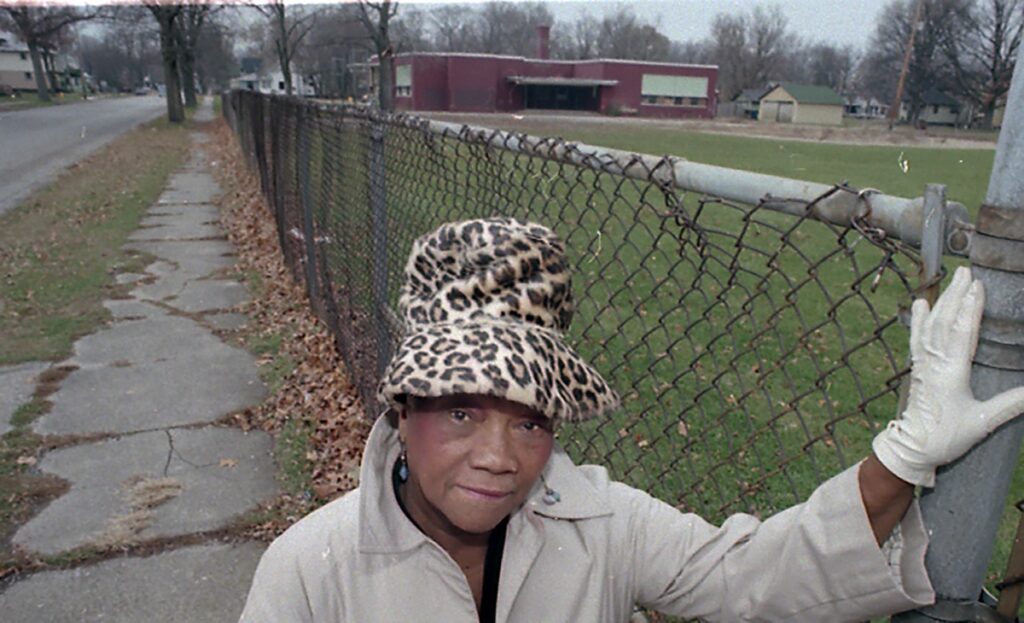
“She was always at the forefront of any issue. When she stands for something, she will not fall for anything. She helped desegregate Elkhart. She’s always working to dismantle racism,” said Arvis Dawson, then-Black Expo president and a city councilman, in a 2003 tribute to the woman known as Elkhart’s Mother Love.
On Aug. 8, 2026, the late Edith Pasley will have the park and playground at Sixth and Cleveland streets in Elkhart renamed in her honor. It’s a patch of land for which she cared deeply in her lifelong work to make Elkhart better.
‘To say nothing is to give consent’
A resurgence of the Klan in Indiana during the mid-to-late 1990s brought demonstrations to Elkhart and neighboring communities. Masked members attempted to make their presence known at school board and government meetings and public places. They planned rallies to espouse their white supremacist beliefs.
In the spring of 1998, Elkhart city leaders wanted to avoid verbal and potentially physical confrontations at the Courts Building parking lot where the KKK intended to gather. Plans for an alternative and positive event were made in hopes of taking the focus away from downtown.
Edith Pasley absolutely wanted none of that.
“The city plans to have a picnic while the city burns. That’s the coward way out,” she told The Elkhart Truth’s Rick Meyer for a March 11, 1998, article. “To say nothing is to give consent and say it’s OK.”
The head of a KKK sect sent a letter to Pasley discouraging any such interaction and confrontation, according to a March 24, 1998, report.
When asked if she was worried about being physically harmed at the rally, Pasley told a reporter with her usual resolve. “When the Lord leads you,” she said, “He takes care of all that. We hope to meet some of (the Klan members), talk to them, shake hands, tell them about the Lord and invite them to our churches. We talk to them every day, not knowing who they are.”
The Associated Press made Pasley the featured subject of resistance in a May 1998 report about the KKK. “Her eyes (are) open. … Edith Pasley is still fighting,” the reporter wrote.
She met these displays of hate head on, unfaltering, strong.
In 2000, when the Klan planned another public display of force, Pasley told The Truth’s Justin Leighty, “(W)hat the world needs is love. There’s not enough love in the country. You have to keep prayerful to love those that spitefully use you. We have to let them know God loves them too … we just have to be educated to the fact and stop using hate in this world.”
Shining a light
Upon her passing in June 2006, Arvis Dawson recalled Pasley’s work in simple and effective terms. “(F)eisty. If the downtrodden needed spoken for, she would speak for them. … If it needed done, she would do it … (but) it was never about Edith.”
She was a champion for the forgotten and oppressed and disadvantaged. Time spent working within the community during the 1950s and ‘60s turned into a three-year leadership assignment as president of the local NAACP chapter from 1971-74.
It was a volatile period in the city of Elkhart. Relationships among high school students were turbulent. Neighborhoods twisted with unrest.
May 1971 brought a particularly difficult period.
Pasley condemned city hall and the police department for actions taken against Blacks. In particular, according to The Truth’s Michael Arnolt, she sought answers about accusations of brutality, tactics of K-9 units, and excessive patrols.
Schools were not exempt from her ire, as Pasley described the high school as a “critical and terrible situation.”
And under her leadership, the NAACP protested hiring practices at the Kentucky Fried Chicken on Benham Avenue, alleging discrimination in hiring practices.
Her leadership kept focus on problems. KFC’s corporate leaders responded to the picket within days and announced they would hire their first Black teen. Harold Oyer, the Elkhart Schools superintendent, acknowledged a “gross misunderstanding” between the races and announced the schools would be introducing for the 1972-73 school year an effort to teach young students about the roles of Black Americans throughout American history.
The police situation proved more difficult to advance. By late summer, Pasley criticized the Human Relations Commission for predetermining the outcome of its investigation. The head of the city board implied the slate would be wiped clean unless allegations could be fully substantiated.
“They should find their own facts,” Pasley said. “They should talk with the mothers who have filed complaints with us. They should start investigating from the beginning and talk directly with the people involved. We’re not going to do their work.”
Needs in the neighborhood
Controversy ended Pasley’s run as NAACP leader. A private, unreported complaint was made to organizational leaders about her. She said it was “impossible for me to work with board members” after that, and resigned in August 1974,
By the next month, her next volunteer venture began. The New Breed of Women in Politics organized to see more women put their names forward as candidates for the 1975 city election. A decade later, she finally put her hat into elective politics, ultimately coming up 268 votes short in the race to succeed Democrat Ben Barnes on the Elkhart County Council.
She remained in the fight, but her priorities were turning to senior issues.
By 1993, Pasley was working to turn the former Ullery School building at Sixth and Cleveland streets into a community center. Tolson Center was for the kids, she said, and older adults needed a place to go. But the building was in need of serious help – a new roof, an interior redesign for efficiency, a clean up from vandalism and fire.
The original building on the site went up in 1891, and South Side School was enlarged in 1909. Extensive changes were made in 1951, when the schools chose to honor educator, administrator and board member Jacob Ullery. But by 1977, only kindergarten through second grade students attended, and the building ultimately was closed.
Without the means to adequately fund the improvements, Pasley’s dream of Carter-Ermine Senior Center was ended and the building was torn down.
The 2026 revitalization of the site includes a splash pad, open-air shelter, walking paths and a toddler play area. Along with the improvements, Pasley will be honored in the park’s new name.
Passion and strength
A graduate of the Madam CJ Walker Finishing School in Indianapolis, Edith Pasley ran Edie’s Cosmetology Shop for decades, and every day, she took her faith to work. “I talked Jesus with the people,” she said in a 2003 Truth article. “I didn’t bore them. I just got a little word in now and then.”
She often recalled for reporters the pride she felt in meeting W.E.B. Dubois at a national event in 1958, just prior to his international travels promoting African liberation from colonial interests. And she was quick to recount the inspiration of hearing Rev. King’s “I Have a Dream” speech on the National Mall in 1963.
Her passion, though, was sparked as a child, sitting on the knee of her great-grandmother, who lived to be 106. “She could not read or write,” Pasley said, “so she just told me real stories about slavery.”
It didn’t matter if she held an official title or position. When Pasley saw something wrong, she sought to make it right.
Ideal Beach was for whites only into the 1960s. One day, Pasley and Mary Carter led a group of about 30 Black teens to the Heaton Lake attraction. One person at the gate told them it was a private beach, according to a February 2003 article by The Truth’s Alyssa Ford. Attendants went to make a phone call about the situation … and Pasley opened the gate and waved everyone through.
“When the Blacks got in the water,” she told Ford, “every Caucasian got out. They closed the concession stand.”
Carter told the reporter, “Edith just proved her point. She didn’t get out of order or anything. She held her guns. It opened up the way. Those people (at the gate) were lying. They didn’t want us there because we were of another color.”
In June 2006, Pasley was eulogized as “Elkhart’s Mother Love” for her care and attention to community. Cora Breckenridge, an Elkhart resident and member of the NAACP national board, remembered her friend: “We feel we have lost a great and valiant warrior. She had really worked to make a difference. She was a faithful servant.”